
Daily Nutrition · Seasonal Cooking
What the Rhythm of Seasonal Eating Has Taught a Busy London Kitchen
Beatrice Marsden
·
 Tobias Ashcroft
Portion control is rarely a subject that welcomes quiet observation. The language that surrounds it tends toward the instructive — the measured gram, the calorie logged, the plate divided into quadrants by a dietary rubric. And yet, for those who have spent time paying genuine attention to how much arrives on a plate versus how much the body requires, a more considered picture emerges: one in which the practice of portion awareness is less a discipline than a form of attentiveness, developed over time, through repeated, unhurried meals.
Contemporary food culture has made abundance the baseline condition. The standard restaurant portion in the United Kingdom has grown considerably over the past two decades — a pattern documented in published nutritional research as well as in the lived experience of anyone who has ordered the same dish from the same establishment over a span of years. The serving that arrives has become, by default, the serving that is consumed.
This is not a moral observation. Abundance is not a failure of character; it is an environmental condition. The relevant question for everyday nutrition is how a person navigates an environment calibrated for over-serving without regarding every meal as a site of disciplined resistance. The answer, as far as the published literature on mindful eating suggests, lies not in restraint but in attention.
Attention to portion sizes, in practice, means pausing before eating to observe what is present on the plate. It means noticing the architecture of the meal — the ratio of vegetables to grains to protein-rich ingredients — before the first bite. This act of observation, practised consistently, builds an internal sense of proportion that eventually operates without conscious effort. The nutritionist's language for this is intuitive eating; the kitchen's language is simply paying attention.

One of the more useful reframings in contemporary nutrition writing is the approach of hunger as a signal to be read rather than an instruction to be obeyed. Hunger is not a uniform experience — it arrives in gradations, and the practice of portion awareness begins with learning to distinguish between them. The hunger that appears ninety minutes after a complete meal is different in character from the hunger that arrives six hours later. Attending to this difference changes the relationship to snacking, to second helpings, and to the kitchen's rhythm across the day.
This is not an argument for ignoring hunger, nor for regarding it as a problem to be managed through willpower. It is an observation about the value of developing a more granular vocabulary for the body's signals. Nutritionist guidance on weight management consistently notes that individuals who eat more slowly — and who pause between portions to assess their level of fullness — make different choices at the table than those who eat quickly and without interruption. The pace of eating is as significant as the composition of the meal.
The active lifestyle kitchen has particular reason to attend to hunger signals. Training and sport alter hunger patterns in ways that are not always intuitive: intense exercise can suppress appetite in the short term while increasing caloric need over a longer window. The athlete or active person who eats only when acutely hungry may be systematically under-fuelling, while the sedentary individual who eats at fixed intervals regardless of hunger may be consistently over-consuming. Portion awareness, in this context, means calibrating attention to actual need rather than to habit or schedule.
"The portion that satisfies is rarely the one that arrives. It is the one that the eater, paying close attention, decides is sufficient — and that decision is a skill, not a restriction."
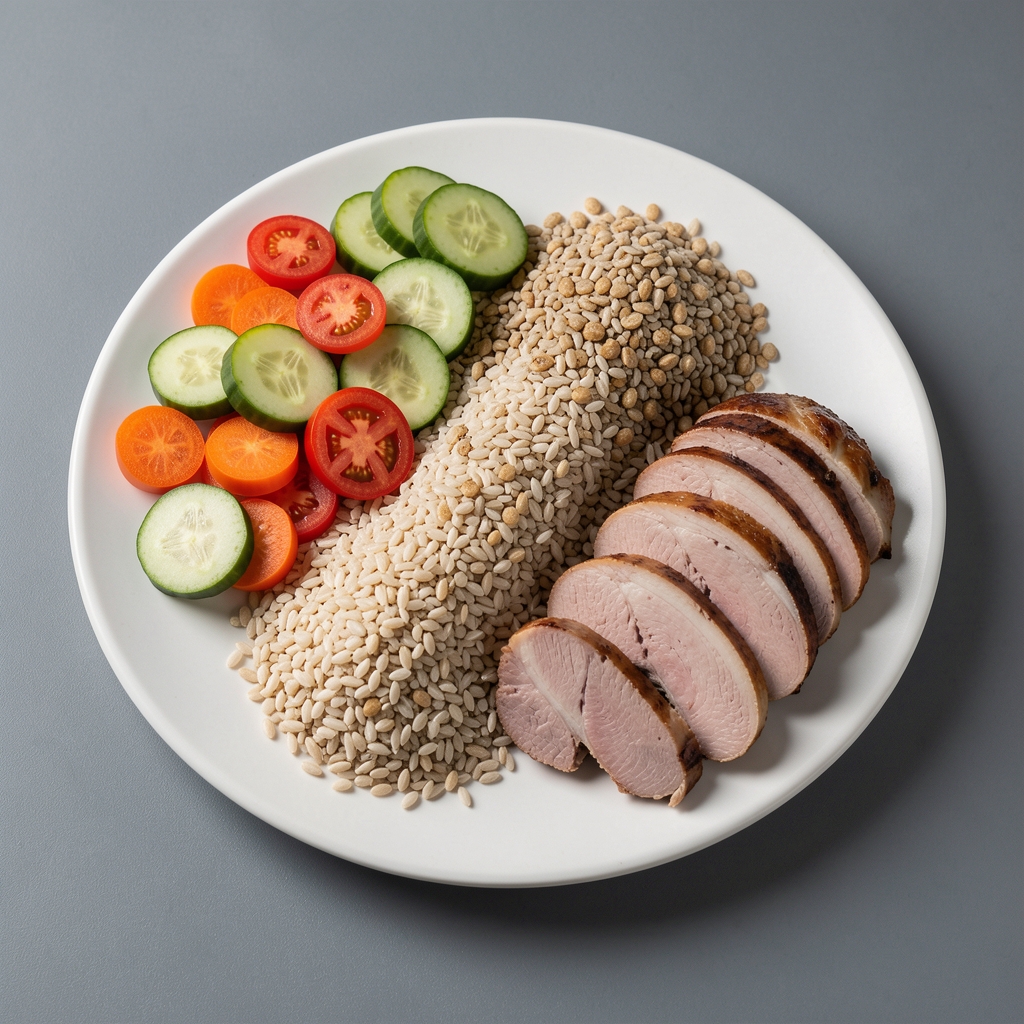
For those interested in balanced meals, the plate offers a useful compositional frame. Nutritional frameworks for healthy eating habits commonly describe an ideal plate in terms of proportions: a substantial share of vegetables, a moderate portion of whole grains, a smaller element of protein-rich food. This structure is not arbitrary — it reflects the macronutritional and fibre composition that published research associates with sustained energy and stable appetite across the hours following a meal.
In practice, composing a plate according to this structure requires a shift in the logic of meal planning. Most of the habits around which Western cooking has organised itself for the past century place protein at the centre and vegetables at the periphery. The shift toward a vegetable-centred plate is not a reduction in pleasure — it is a reorientation of what the meal is built around. The structural consequence is a natural moderation of the protein portion without any need for measurement.
Whole foods — unprocessed grains, legumes, root vegetables — also contribute to portion moderation through a mechanical pathway. Their fibre content creates a sense of fullness that processed foods do not, which means that a meal built around whole foods tends naturally to produce satisfaction at a lower volume. Meal planning that incorporates these foods reduces the perceptual gap between the portion available and the portion required.
The literature on portion awareness identifies several recurring practical adjustments that individuals report making as their attention to this subject develops. They are not a programme; they are observations that have recurred often enough to note.
The first is the shift to smaller plates and bowls. Visual cues have a documented influence on the quantity a person will serve themselves, and the large plate creates visual permission for a large portion regardless of actual hunger. Switching to a smaller plate is not a trick — it is a recalibration of the visual context in which the eating decision is made.
The second is the practice of serving from the kitchen rather than from the table. When dishes are placed on the table family-style, the availability of additional food within reach is a consistent prompt for additional consumption. Serving a portion in the kitchen and returning to the table without the remaining dish removes one environmental cue for over-serving.
The third is a pause at approximately two-thirds through a meal. Not a formal interruption, simply a moment of attention to the body's current state. This pause, noted in published research on eating behaviour, is reported to reduce the frequency of consuming food beyond the point of comfortable fullness. It costs nothing and requires no equipment.
Attention to portions need not operate meal by meal. There is a broader rhythm — the weekly cadence of diet and nutrition — within which portion awareness operates at a more aggregate level. A week in which three or four evenings have produced meals with generous vegetable portions and modest grain or protein elements will, as a pattern, produce a different aggregate nutritional outcome than a week in which those proportions are inverted, regardless of what happens on any single day.
This weekly perspective is particularly useful for those who travel, eat out regularly, or have schedules that make consistent daily meal planning difficult. A restaurant meal or a convenience meal on a Wednesday does not disrupt a week's pattern if the surrounding meals have been attentive. The practice of portion awareness is cumulative, not binary.
Meal planning that takes this weekly view also allows for a more relaxed relationship with individual meals. The kitchen that knows it will have three structured, vegetable-centred evenings across the week can approach a Friday evening meal with a looser hand, without the anxiety that a single generous portion has undone a pattern of careful eating. The pattern is the practice. The individual meal is a single note in a longer composition.
Tobias Ashcroft is a contributing writer to Otaleven Letters with a background in nutrition journalism and food writing. His editorial work focuses on the intersection of eating behaviour, everyday meal practice, and the quieter aspects of a considered food life.
More from this writer